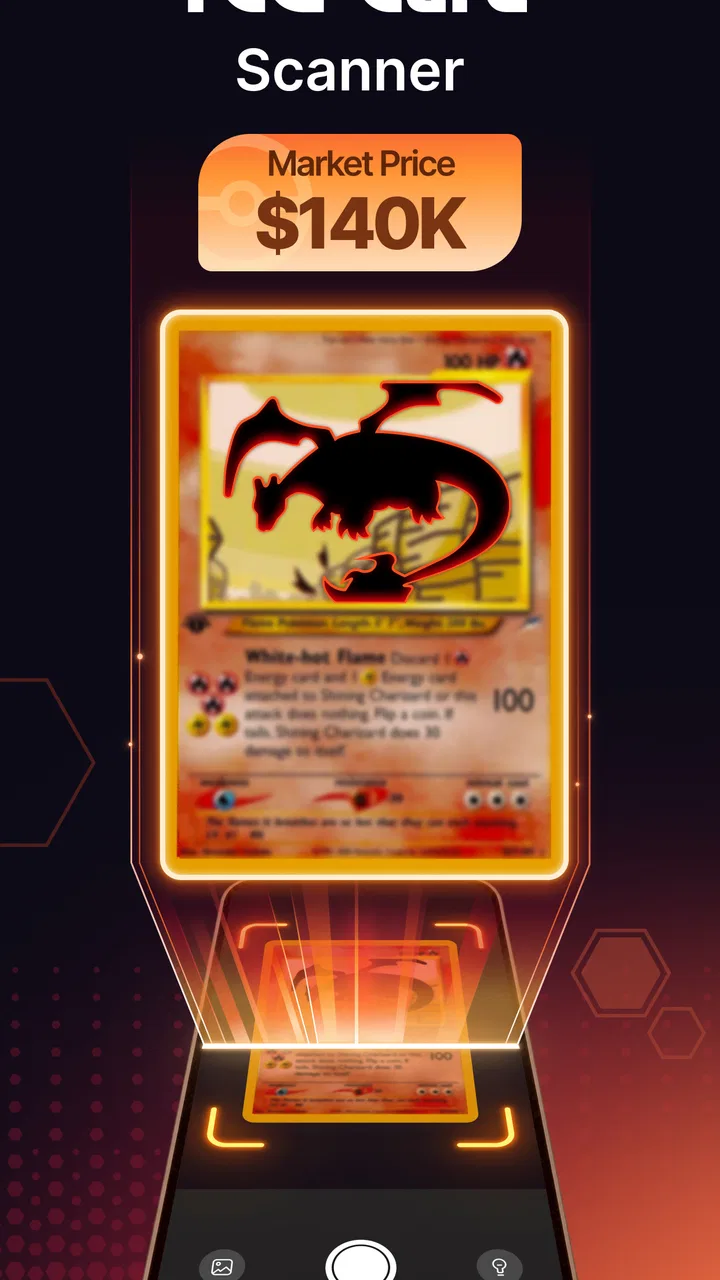
TCG Card Scanner TCG Collector
- 4.7
- Rating
- 1.00M
- Installs
- Free
- Price

 Analysis by App-foxy
I started using TCG Card Scanner TCG Collector with one simple question: can a card-scanning app actually make a growing trading-card collection easier to manage, or does it just add another step? After spending time with it as a sports-category app, I found that its main value is less about replacing a serious collector’s entire system and more about reducing the friction between finding a card, identifying it, and deciding what to do with it next.
The app comes from Identifier Studio and is free to install, with optional in-app purchases ranging from $3.99 to $39.99 per item. It is suitable for Everyone, runs on devices using Android 10 or later, and the current version is 1.1.4. Its public reception is strong, with a 4.6 average from around 21 thousand ratings, while more than 500 thousand people have installed it. Those figures suggest that the basic idea is connecting with collectors, but my recommendation depends on how you plan to use it.
Why the scanner matters more than the collection label
The verified capability I kept returning to is the card identifier. A collection app can be useful once every card has already been named and organized, but that first step is usually the tiring one. Looking at a card, reading a small set symbol, checking a number, and distinguishing between similar printings can turn a box of cards into an evening-long sorting project. A scanner aims to shorten that process.
You May Also Like

 Blood Strike: 2.5 Anniversary
Blood Strike’s Loadouts Turn Every Drop Into a Tactical Gamble
A close look at Blood Strike’s custom loadouts: how fast access to signature weapons reshapes its battle royale rhythm, rewards preparation, and narrows the gap between fights.

 Pandora - Music & Podcasts
Pandora’s Music Is Easy to Start, but Harder to Recover
Pandora’s strength is its low-effort path from a seed to a station. Its weak spot is how much confidence it asks you to place in connection, setup, and quiet recovery.

 8 Ball Pool
 Is Built on Rivalries, Rematches, and Routine
A close look at the rivalries, rematches, shared routines, and unanswered safety questions that turn a quick pool match into a persistent mobile community.

 Samsung Music
’s Quiet Strength Is Playing What You Already Own
Its reach comes less from spectacle than from dependable access to a personal library. That simplicity is both the app’s strongest retention engine and its ceiling.

 AccuWeather: Weather Radar
AccuWeather Review: A Quick, Clear Forecast for Everyday Decisions
For everyday plans, the best forecast is the one you can understand quickly. AccuWeather makes rain timing, radar, and local conditions easy to act on, with a few trade-offs.

 Hill Climb Racing
Why Hill Climb Racing Still Turns Crashes Into One More Run
A tiny car, a bumpy hill and one more upgrade: Hill Climb Racing keeps resurfacing because its simple chaos makes every near-miss feel personal.
More From Our News Desk



That sounds like a small convenience until you have a mixed pile in front of you. Cards from different sets can look nearly identical at a glance, and a collector may not remember which details separate one printing from another. The practical effect of identification is that it gives the rest of the collection workflow a starting point. Instead of opening a catalog and guessing search terms, I can begin with the physical card in my hand.
I also like the fact that the app presents itself as more than a single-purpose camera tool. Its store summary combines scanning, collecting, card identification, and card value. That combination makes sense for the moment when curiosity turns into an inventory decision: identify the card, record it, and then consider whether it belongs in a personal collection, a trade pile, or a sale box.
Still, I would not treat the scanner as an automatic expert. Card identification is most useful when the card is visible, reasonably well presented, and not confused by unusual printing details. A scan can save time, but it does not remove the need to look closely at the result. My best habit was to use the scan as a first answer, then verify the name and edition against the card itself before treating the entry as final.
What the scanning workflow changes
The biggest improvement is not simply speed. It is attention. When I sort manually, I tend to postpone cards that are unfamiliar or visually similar. Once those cards are left in a separate pile, the pile becomes its own problem. A scanner gives each card an immediate next action, which makes it easier to keep moving through the collection instead of building a backlog.
There is also a useful psychological difference between searching for a card and scanning one. Search assumes that I already know enough to describe the item. Scanning starts from the object itself. That is especially helpful for newer collectors, inherited collections, or boxes assembled over many years, where the owner may recognize the artwork but not the set or card number.
For experienced collectors, the benefit is different. The app can serve as a triage tool. I would not use it as the only authority for high-value decisions, but I would use it to separate ordinary cards from items that deserve closer research. That distinction matters because it prevents the same amount of effort being spent on every card.
How I would use it during a real sorting session
My preferred workflow is to prepare three physical groups before scanning: cards I want to keep, cards I need to investigate, and cards that may be duplicates or trade candidates. I then scan the uncertain group first. This prevents the app from becoming a distraction while I am already confident about the rest of the collection.
After identifying a card, I would immediately decide what information is worth retaining. If it is a card I plan to keep, it belongs in the collection record. If it is a duplicate, it should be marked mentally or physically so it does not get scanned repeatedly. If its apparent value is the reason for the scan, I would set it aside for a second look rather than making a rushed decision from one result.
This two-pass approach is one of the more useful ways to get value from the app. The first pass is about recognition; the second is about judgment. It avoids a common mistake with collection tools, where every displayed result is treated as a final verdict. The app can organize the information, but the collector still has to account for condition, edition differences, language, and whether the card is actually the same version shown in the result.
Lighting and presentation also matter in practice. I found that a clean, flat card is a better candidate for scanning than one partly covered by a sleeve glare or buried in a stack. If a result looks uncertain, moving the card onto a plain surface and making the identifying details easier to see is more sensible than repeatedly forcing the same scan. This is a small habit, but it saves time and reduces duplicate entries.
The strongest everyday scenario
The best scenario for this app is a collector who has just returned from a trade, opened several packs, or inherited a mixed box and wants a useful overview without building a spreadsheet from scratch. Imagine sorting cards at the kitchen table after a local event. You remember which cards interested you, but you do not remember every set, number, or possible duplicate. The scanner turns that uncertain pile into a sequence of identifiable items.
In that situation, I would not begin by trying to calculate the total worth of the collection. I would first identify the cards, record the ones I want to keep, and isolate anything that deserves more research. This order is important because a value-focused workflow can encourage unrealistic expectations. A card may appear interesting in a result while its real condition or exact variation changes the decision completely.
The app is also a good fit for a parent helping a child organize cards. The Everyone rating makes it approachable for a broad audience, and scanning offers a more engaging entry point than asking a young collector to type every name into a database. The adult should still guide decisions about trades, purchases, and value, but the identification step can make the activity feel less like paperwork.
Another practical use is preparing for a move. When a collection has to be packed, donated, sold, or divided among family members, the hardest part is often knowing what is actually in the boxes. A scanning workflow can help create a rough inventory before the cards disappear into storage. I would think of that inventory as a working record rather than a formal appraisal, but it is still far more useful than relying on memory.
Where it compares well with manual alternatives
The usual alternative is a browser search, a spreadsheet, or a notebook. Those methods can be excellent when the collector wants complete control, but they put more responsibility on the person doing the sorting. A spreadsheet is flexible, yet it does not identify an unknown card by itself. A notebook is quick for personal notes, but it becomes difficult to search once the collection grows. Manual searching can be accurate, but it is slow when the starting information is incomplete.
This app’s advantage is the bridge between the physical card and the digital record. It is designed around the moment where the collector needs help recognizing what is in front of them. That makes it more approachable than building a database from zero, especially for people who want an organized collection without learning a complicated cataloging system first.
On the other hand, a spreadsheet remains better for collectors who need custom fields, detailed condition notes, purchase history, insurance documentation, or a carefully controlled valuation record. The app is also not a substitute for specialist research when a card is rare, damaged, altered, or difficult to distinguish from a related printing. In those cases, the flexibility and transparency of manual documentation can be more valuable than convenience.
The tradeoff between convenience and confidence
The central tradeoff is simple: the faster the first identification becomes, the more important it is to review what was identified. A scanner reduces repetitive work, but it can also create false confidence if I accept every result without checking the physical card. That matters most when the next step involves trading, selling, or deciding that a card is valuable.
I would therefore separate three questions that are easy to blur together. First, what card does this appear to be? Second, is this the exact printing or variation I own? Third, what is this particular copy worth in its current condition? The app is most useful at the first question and can support the next steps, but the latter decisions require more care than a quick scan.
There is a similar tradeoff with in-app purchases. The app is free to start, which makes it easy to test whether the scanning and collection workflow suits you. Optional purchases may make sense for someone who uses it regularly, but I would not buy anything before scanning a representative sample of my own cards. If the app struggles with the types of cards in your collection or its organization style does not match your habits, paying for more access will not solve that underlying mismatch.
The release date of Mar 25, 2025 also places the app in a relatively new stage of its life. That is not automatically a problem, and the current version shows that Identifier Studio is continuing to develop it, but collectors who want a long-established archival system may prefer a more mature tool. I would be comfortable treating this as a convenient working companion rather than the sole permanent record of an important collection.
Who will gain the most from it
I think the strongest audience is the casual or intermediate collector with enough cards to make manual identification tedious, but not so many that they need a highly specialized inventory platform. The app is particularly appealing if you often receive mixed lots, collect across different sets, or want to know what you have before deciding how to organize it.
It also suits people who are motivated by discovery. Scanning a card can turn a forgotten box into a guided sorting project, and that immediate feedback is more inviting than starting with blank spreadsheet columns. For someone building a collection gradually, the app can provide a repeatable habit: identify new cards when they arrive, keep the collection current, and separate uncertain items before they become a larger cleanup job.
I would be more cautious about recommending it as the only tool for a professional seller, a high-end collector, or anyone documenting cards for insurance. Those users need a level of detail and verification that goes beyond recognition. They may still find the scanner useful for initial sorting, but they should maintain an independent record for condition, provenance, exact variant, and transaction history.
There is also a group that should probably skip it: people who own only a small number of cards and already know every item by sight. In that case, the setup and scanning process may take longer than simply writing down the few cards that matter. The app earns its place when uncertainty and volume create friction; it is less compelling when neither problem exists.
My practical recommendation
I recommend starting with a controlled test rather than importing or scanning an entire collection at once. Choose cards that represent the real mix you own: familiar cards, duplicates, older cards, cards with similar artwork, and a few items whose identity you are unsure about. This reveals whether the app helps with your collection instead of an imaginary average collection.
Keep the physical cards in the same order as the digital work until you have checked the results. That simple precaution makes corrections easier and prevents a confusing pile of unidentified cards from being mixed back into the finished group. For valuable-looking cards, photograph or note the physical details separately, because identification and condition are different jobs.
I would also use the app to make decisions in stages. Scan first, organize second, investigate third, and only then consider a trade or sale. That sequence protects against the most common mistake: treating a convenient result as a complete valuation. It also makes the app feel less like a price-chasing tool and more like what it does best, which is helping a physical collection become understandable.
After using it this way, I see TCG Card Scanner TCG Collector as a practical entry point into digital card organization. Its scanner is the feature that gives the rest of the experience a reason to exist, especially when a collection contains unknown cards or has grown beyond easy memory. The free starting point lowers the risk of trying it, while the optional purchases mean regular users should decide carefully whether the expanded workflow justifies spending.
My final opinion is positive, with one important condition: use it as an assistant, not an unquestionable authority. It can save real time, make sorting less intimidating, and help a casual collector build a useful inventory. It is not the right replacement for detailed records or specialist verification when money and rarity are involved. If your main problem is identifying and organizing a messy pile of trading cards, this app is worth trying. If your main problem is formal appraisal or advanced collection accounting, a more customizable system will serve you better.
FAQs for TCG Card Scanner TCG Collector
01What is the TCG Card Scanner TCG Collector app used for?
The TCG Card Scanner TCG Collector app is designed for trading card enthusiasts who want to efficiently manage their collections. It allows users to scan, catalog, and organize their trading cards. The app supports various trading card games (TCGs) and provides a comprehensive way to track the value and details of each card.
02How accurate is the card scanning feature in TCG Card Scanner TCG Collector?
The card scanning feature in TCG Card Scanner TCG Collector is highly accurate, leveraging advanced image recognition technology to identify cards. However, accuracy may vary based on lighting conditions and card positioning. It's recommended to scan in well-lit environments and ensure the card is properly aligned for the best results.
03Is the TCG Card Scanner TCG Collector app available for both Android and iOS devices?
Yes, the TCG Card Scanner TCG Collector app is available for both Android and iOS platforms. Users can download the app from the Google Play Store for Android devices and the Apple App Store for iOS devices, ensuring accessibility across most smartphones and tablets.
04Does TCG Card Scanner TCG Collector support multiple trading card games?
Absolutely, the TCG Card Scanner TCG Collector app supports a wide range of popular trading card games. This includes major TCGs like Magic: The Gathering, Pokémon, and Yu-Gi-Oh! among others, allowing collectors to manage diverse collections within a single application.
05Are there any in-app purchases or subscription fees for TCG Card Scanner TCG Collector?
The TCG Card Scanner TCG Collector app offers both free and premium features. While basic functionalities are available at no cost, users can opt for in-app purchases or subscriptions for enhanced features such as advanced card analytics, cloud backup, and ad-free experience. Pricing details are available within the app itself.
Pros
- Fast card recognition feature.
- Supports multiple TCGs seamlessly.
- User-friendly interface design.
- Accurate collection tracking.
- Regular updates enhance functionality.
Cons
- Occasional misreads on rare cards.
- Limited offline functionality.
- Ads can be intrusive at times.
- Requires internet for full features.
- High battery usage during scans.

TCG Card Scanner TCG Collector
Gallery